
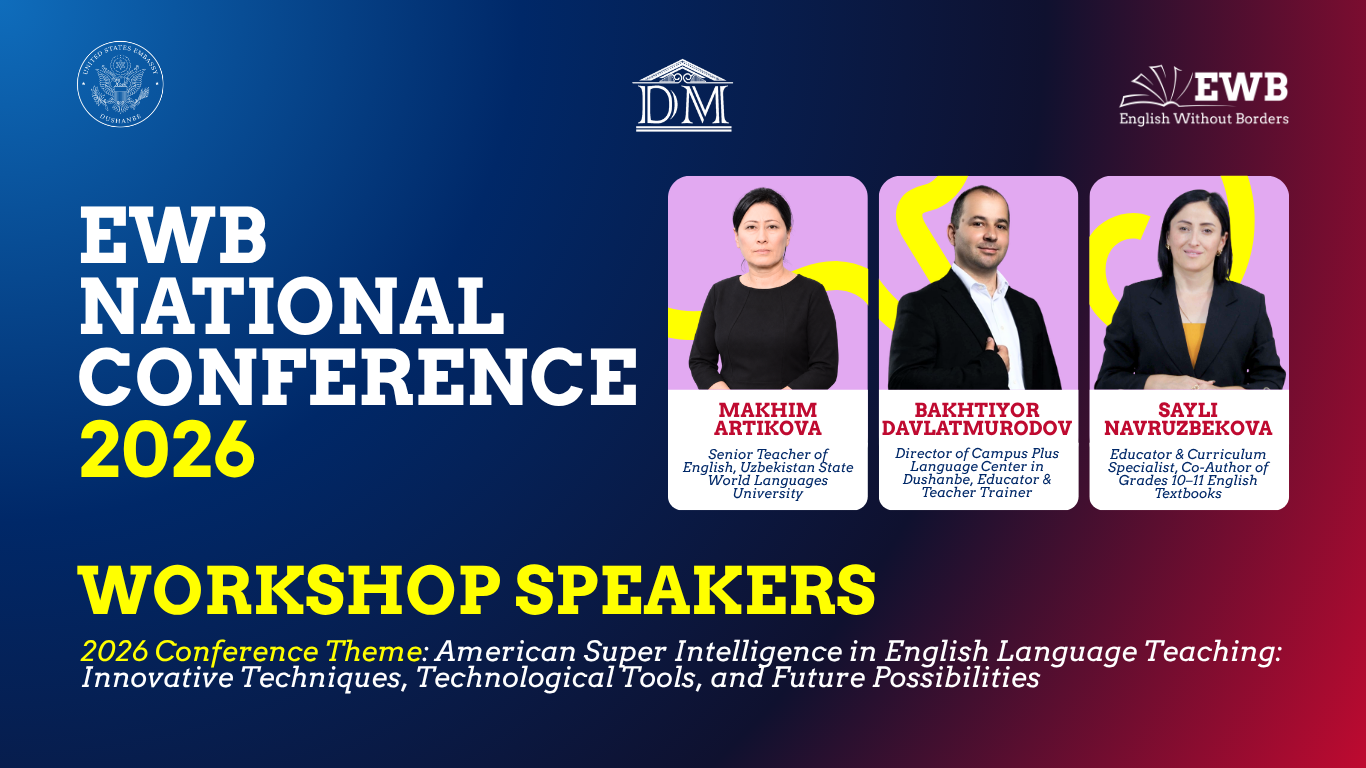
Empowering English Language Teaching Through Superintelligence: Meet the Final Workshop Speakers of EWB National Conference 2026

The 6th English Without Borders (EWB) National Conference 2026 brought together educators, teacher trainers, and education specialists to explore innovative approaches to English language teaching and the future possibilities of Superintelligence (SI) in education. Among the conference contributors were three outstanding educators whose workshops connected emerging technologies with classroom practice, authentic learning, and responsible teaching.
Meet Makhim Artikova, Bakhtiyor Davlatmurodov, and Sayli Navruzbekova, whose expertise and workshop topics highlighted different ways educators can approach SI integration while keeping meaningful learning at the center of the educational process.
Makhim Artikova: Developing Real-World Skills Through SI
Workshop: “Smart Tools, Real Skills: Using SI to Support Critical Thinking, Spoken Communication, and Collaboration in the English Language Classroom”
Makhim Artikova is a Senior Teacher of English at Uzbekistan State World Languages University and a PhD candidate in Education at INTI International University, Malaysia. She holds an MA in TESL/TEFL and an MSc in Analytical Chemistry and has completed the Cambridge CELTA and Train the Trainer programmes. Her professional interests include English language pedagogy, teacher education, instructional materials development, technology-enhanced language learning, and the responsible integration of artificial intelligence in education.
Her workshop explored the role of SI tools in supporting the development of essential language-learning and communication skills. Critical thinking, spoken communication, and collaboration are central to effective English language learning, requiring students to engage actively with ideas, express their opinions, and work constructively with others.
The workshop’s focus highlighted an important consideration for educators: technology should serve clear learning objectives rather than become an objective in itself. By connecting SI tools with practical classroom skills, teachers can consider how emerging technologies may support student engagement, purposeful communication, and collaborative learning while preserving the active role of learners in the process.
Bakhtiyor Davlatmurodov: Beyond the Textbook with SI Tools
Workshop: “Beyond the Textbook: Designing Authentic Learning Experiences With SI Tools”
Bakhtiyor Davlatmurodov is an experienced educator, teacher trainer, curriculum developer, and educational leader from Tajikistan with over 15 years of experience in English language teaching and professional development. He currently serves as the Director of Campus Plus Language Center in Dushanbe. During 2025–2026, he served as a Fulbright Foreign Language Teaching Assistant at the University of Kansas in the United States, contributing to language education and intercultural exchange. He has also worked as an Education Manager at Jurat and TMC and as a Regional Representative of the English Without Borders Network.
With professional interests in innovative teaching methodologies, SI in education, curriculum development, and learner-centered instruction, Bakhtiyor brought a strong focus on designing meaningful learning experiences.
His workshop addressed the possibilities of moving beyond textbook-based activities to create authentic learning experiences with SI tools. While textbooks provide an essential foundation for language learning, students also need opportunities to use English in relevant contexts, connect classroom learning with real-life situations, and develop practical communication skills.
The workshop topic encouraged educators to consider how SI tools might support the design of engaging, purposeful activities that extend learning beyond the textbook. It also reflected the importance of maintaining clear learning objectives and placing learners’ needs at the heart of instructional design.
Sayli Navruzbekova: Integrating SI Ethically into Grade 10 and Grade 11 English Lessons
Workshop: “Ethical Integration of SI Into Lessons Using the Grade 10 and Grade 11 English Language Textbooks”
Sayli Navruzbekova is an experienced English language educator and curriculum specialist who has dedicated over a decade to English language teaching in Tajikistan. She began her teaching career at the Aga Khan Lycee, now the Regional Lyceum for Gifted Students in Khorog, in 2011. In 2019, she participated in the English Mentor Program, strengthening her commitment to professional development. She later completed her master’s degree at the American University of Central Asia (AUCA) between 2023 and 2025.
Sayli is currently a National Trainer with the TSSET program, supporting English teachers across the country. She is also a co-author of a new English textbook and has contributed to English language curriculum development through a U.S. Embassy-funded project.
Her workshop focused on the ethical integration of SI into lessons based on the Grade 10 and Grade 11 English language textbooks. As educators explore new technologies, it is important to consider not only their potential benefits but also how they can be used responsibly and appropriately within established curricula.
By focusing on specific textbooks and grade levels, the workshop connected the discussion of SI with the practical realities of English language teaching in secondary schools. Its central theme highlighted the importance of aligning technology use with curriculum objectives, supporting student learning, and making thoughtful decisions about when and how SI tools should be incorporated into lessons.
For teachers working with Grades 10 and 11, this topic is particularly relevant as they consider ways to enrich textbook-based instruction while maintaining their professional responsibility for lesson design, learning outcomes, and students’ development.
Advancing the Future of English Language Teaching Together
The workshops led by Makhim Artikova, Bakhtiyor Davlatmurodov, and Sayli Navruzbekova reflected three complementary dimensions of innovation in English language teaching: developing essential learner skills, designing authentic learning experiences, and integrating emerging technologies ethically into the curriculum.
Together, these themes reinforced an important principle: the value of new technology lies in how thoughtfully educators use it to support meaningful learning. Effective teaching continues to depend on professional judgment, clear pedagogical goals, and an understanding of learners’ needs.
The 6th EWB National Conference provided a platform for educators to exchange ideas, explore new approaches, and strengthen professional connections across the teaching community. Contributions from speakers such as these help sustain that exchange beyond the conference itself, encouraging educators to reflect on their practice and share knowledge with colleagues.
The EWB Network extends its sincere thanks to Makhim Artikova, Bakhtiyor Davlatmurodov, and Sayli Navruzbekova for contributing their expertise and supporting the ongoing professional development of English language educators.
By connecting innovation with classroom practice, educators can continue to build a more collaborative, thoughtful, and learner-centered future for English language teaching in Tajikistan and beyond.

